
Roller chains are widely used in industrial machinery, conveyor systems, agricultural equipment, motorcycles, and power transmission applications. To connect the two ends of a roller chain and form a continuous loop, a special component called a master link, also known as a connecting link, is required.
Although relatively small, the master link plays an important role in the overall performance and safety of a chain drive. Selecting an incorrect link or installing it improperly can cause chain separation, excessive wear, equipment damage, or unexpected downtime.
Different roller chain designs use different connecting mechanisms, including spring-clip links, cotter-pin links, riveted links, and offset links. Each has its own structural characteristics, installation requirements, and suitable applications.
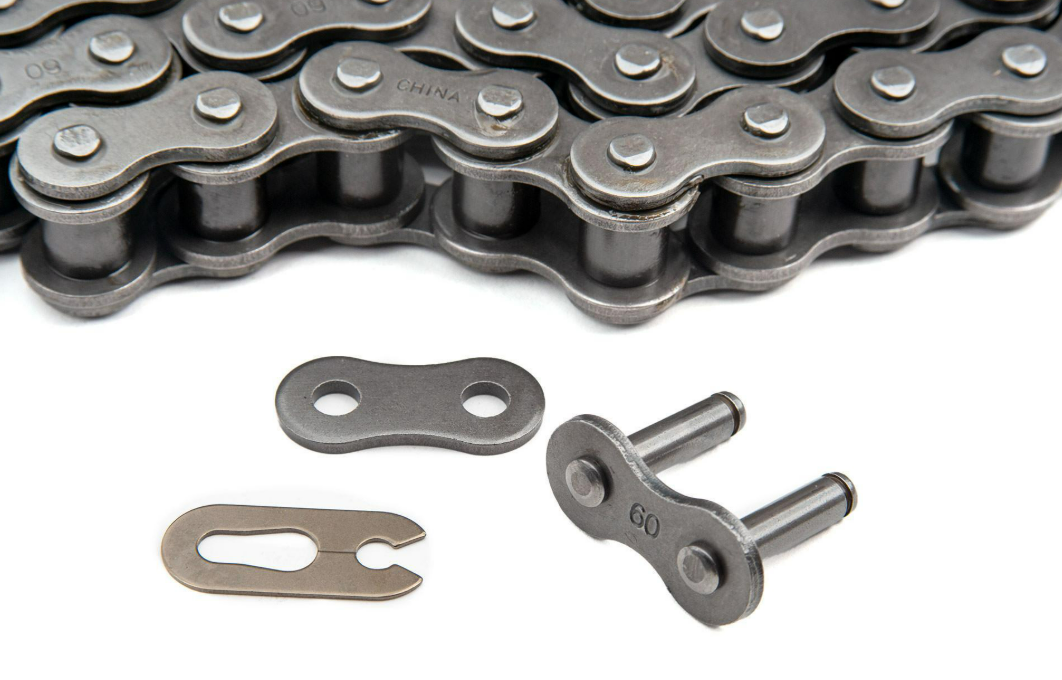
1. What Is a Roller Chain Master Link?
A roller chain master link is a specially designed connecting component used to join two open ends of a roller chain, creating a continuous loop around sprockets.
A standard roller chain consists of inner links, outer links, pins, bushings, and rollers. Unlike ordinary chain links, a master link allows the chain to be connected or disconnected without completely dismantling the chain assembly.
A typical master link consists of:
Connecting pins: Extend through the chain's inner link bushings to connect the chain ends.
Connecting plates: Hold the pins in position and maintain the structural integrity of the connection.
Retaining mechanism: A spring clip, cotter pin, or other fastening method secures the outer plate.
Because the master link forms part of the chain's mechanical load path, its dimensions, strength, and fastening method must match the chain specification.
2. Main Types of Roller Chain Master Links
Different industrial applications require different master link constructions. The most common types include the following.
2.1 Spring Clip Master Links
Spring clip master links use a removable spring steel clip to secure the connecting plate onto the two connecting pins.
Main features:
Easy to install and remove.
Convenient for routine maintenance.
No specialized riveting equipment required.
Suitable for many standard roller chain applications.
Typical applications:
General industrial machinery.
Agricultural equipment.
Light- and medium-duty chain drives.
Conveyor systems where the chain manufacturer permits clip-type connectors.
One important installation detail is the clip orientation. For the conventional spring-clip arrangement, the closed end should face the direction of chain travel, unless the manufacturer's instructions specify otherwise.
2.2 Cotter Pin Master Links
Cotter pin master links use split cotter pins inserted through holes in the connecting pins to secure the outer plate.
Main features:
Positive mechanical retention.
Suitable for certain heavy-duty chain designs.
Reliable fastening when correctly installed.
Require proper cotter pin positioning and bending.
Typical applications:
Industrial conveyor systems.
Heavy-duty machinery.
Agricultural equipment.
Specialized transmission chains.
Cotter-pin links are not interchangeable with spring-clip links unless the chain design specifically supports both configurations.
2.3 Riveted Master Links
Riveted master links use a press-fit connecting plate, with pin ends mechanically riveted or peened to secure the assembly.
Main features:
Permanent connection.
Secure fastening.
Suitable for applications requiring a non-removable connection.
Requires appropriate installation tools.
Typical applications:
Industrial power transmission.
Heavy-duty chain drives.
Continuous-operation machinery.
Applications where the chain manufacturer specifies riveted connections.
Riveted links generally require specialized tools and trained maintenance personnel for correct assembly.
2.4 Offset Links (Half Links)
Offset links, also known as half links, are used to adjust chain length when an odd number of pitches is required.
Unlike conventional master links, their primary purpose is to change the effective chain length rather than simply connect two standard chain ends.
Main features:
Allows odd-numbered chain lengths.
Provides additional flexibility in chain-length adjustment.
Available in different configurations depending on chain series.
Typical applications:
Industrial chain drives.
Agricultural machinery.
Specialized conveyor systems.
However, offset links may have lower fatigue strength or working-load capacity than standard chain assemblies. Whenever possible, an even number of pitches is generally preferred. Follow the chain manufacturer's recommendations.
3. Comparison of Different Master Link Types
Type | Connection Method | Removable | Main Advantage |
|---|---|---|---|
Spring Clip | Spring retaining clip | Yes | Easy maintenance |
Cotter Pin | Split cotter pin | Yes | Mechanical retention |
Riveted | Peened or riveted pin ends | No, normally | Permanent connection |
Offset Link | Special offset plate and pin | Depends on design | Adjusts chain length |
The appropriate master link depends on chain construction, operating load, speed, installation requirements, and manufacturer specifications.
4. How to Choose the Correct Roller Chain Master Link
Choosing a compatible master link requires more than simply matching the chain's nominal size. Several dimensional and mechanical factors must be considered.
4.1 Chain Standard and Series
First, identify the chain standard and series.
Common roller chain standards include:
ANSI (American National Standards Institute).
ISO (International Organization for Standardization).
DIN (German Industrial Standard).
JIS (Japanese Industrial Standards).
For example, ANSI #40 and #41 roller chains both have a nominal pitch of 0.500 inches, but their internal dimensions differ.
Therefore, their master links are not automatically interchangeable.
4.2 Chain Pitch
Chain pitch is the distance between the centers of two adjacent connecting pins.
It is one of the most important dimensions when selecting a master link.
Common ANSI roller chain pitches include:
Chain Size | Pitch (Inches) | Pitch (mm) |
|---|---|---|
#25 | 0.250 | 6.35 |
#35 | 0.375 | 9.525 |
#40 | 0.500 | 12.70 |
#50 | 0.625 | 15.875 |
#60 | 0.750 | 19.05 |
#80 | 1.000 | 25.40 |
#100 | 1.250 | 31.75 |
These are nominal pitch dimensions. The complete chain specification must also be checked.
4.3 Roller Diameter and Inner Width
Two additional dimensions are essential:
Roller diameter: The outside diameter of the chain roller.
Inner width: The distance between the inner plates.
These dimensions affect the fit between the connecting link, standard chain links, and sprockets.
4.4 Number of Strands
Roller chains are available in single-strand, double-strand, and multiple-strand configurations.
The master link must match the number of chain strands. A single-strand connector cannot be substituted for a double-strand or triple-strand connecting link.
4.5 Working Load and Operating Conditions
The master link must have sufficient strength for the application.
Consider:
Working load and transmission power.
Operating speed.
Starting and stopping frequency.
Shock and vibration.
Temperature and environmental conditions.
Lubrication and maintenance requirements.
Do not select a master link based only on its physical dimensions. Its allowable working load and compatibility with the complete chain assembly must also be verified.
5. How to Install a Roller Chain Master Link
Sprockets & Chain | FRC Build System | Welcome
Correct installation is essential for safe and reliable chain operation. The following procedure describes a typical spring-clip master link installation.
Step 1: Prepare the Equipment
Before installation:
Switch off the machine.
Apply the appropriate lockout/tagout procedure.
Secure the equipment against unexpected movement.
Release stored mechanical tension safely.
Wear appropriate protective equipment.
Never install or remove a chain while the drive is operating.
Step 2: Align the Chain Ends
Position the two chain ends so that their inner links align correctly.
Make sure the chain is not twisted and that the connecting pins match the chain's pitch and internal dimensions.
Step 3: Insert the Connecting Link
Insert the connecting pins through the aligned inner link bushings.
Ensure that both pins pass through the chain correctly without forcing or damaging the components.
Step 4: Install the Outer Plate
Position the connecting plate over the two pins.
For spring-clip designs, follow the manufacturer's specified fitting method. The plate must be fully seated without excessive clearance or deformation.
Step 5: Secure the Spring Clip
Install the spring clip into the grooves on the connecting pins.
For conventional spring-clip links, position the closed end of the clip in the direction of chain travel.
Check that both ends of the clip are fully engaged in the pin grooves.
Step 6: Inspect and Test
Before restarting the equipment:
Check the connecting plate position.
Confirm that the retaining clip is fully seated.
Verify that the chain articulates freely.
Check chain alignment and tension.
Inspect the sprockets for wear and damage.
After installation, conduct a controlled test run at low speed, following the equipment manufacturer's safety procedure. Stop immediately if unusual noise, vibration, binding, or abnormal movement occurs.
Important: Riveted and cotter-pin master links require different installation procedures. Always use the correct tools and manufacturer-approved instructions.
6. Common Master Link Installation Problems
Incorrect installation can cause premature wear, chain separation, and equipment damage.
Common Problem | Possible Cause | Recommended Solution |
|---|---|---|
Spring clip falls off | Incorrect orientation or incomplete seating | Reinstall with correct clip engagement |
Connecting plate is loose | Incorrect link dimensions or improper assembly | Verify compatibility and plate fit |
Chain becomes stiff | Misalignment or damaged components | Inspect pins, plates, and articulation |
Excessive chain noise | Poor alignment or incorrect tension | Check sprocket alignment and chain tension |
Premature link wear | Excessive load or incompatible connector | Review chain specification and operating conditions |
Chain repeatedly separates | Incorrect master link or damaged chain | Replace with an approved matching assembly |
7. When Should a Master Link or Roller Chain Be Replaced?
Regular inspection helps identify damage before it causes equipment failure.
A master link should be replaced if you find:
Cracked or deformed connecting plates.
Worn or damaged connecting pins.
Loose or distorted retaining clips.
Missing cotter pins.
Improperly riveted pin ends.
Significant corrosion or surface damage.
The entire roller chain may also require replacement if it shows excessive elongation, stiff joints, damaged rollers, or abnormal wear.
Sprockets should be inspected at the same time. Installing a new chain on severely worn sprockets can accelerate wear and shorten the service life of the replacement chain.
There is no universal chain replacement interval. Follow the chain manufacturer's wear limits and the equipment maintenance schedule.
8. What Information Should You Provide When Ordering Master Links?
To avoid incorrect selections and unnecessary replacement costs, buyers should provide a complete specification when requesting a quotation.
Recommended information includes:
Chain manufacturer and model: Brand, chain number, and product series.
Chain standard: ANSI, ISO, DIN, JIS, or other applicable standard.
Dimensions: Pitch, roller diameter, inner width, and pin dimensions when required.
Strand configuration: Single, double, triple, or multiple strands.
Connection type: Spring clip, cotter pin, riveted, or offset link.
Application: Industrial drive, conveyor, agricultural machinery, or other equipment.
Operating conditions: Load, speed, temperature, and working environment.
Quantity: Required number of connecting links.
If the chain model is unknown, provide photographs, measurements, and a technical drawing to help the manufacturer identify the correct product.
9. Frequently Asked Questions (FAQs)
Q1: What is the difference between a master link and a connecting link?
In roller chain terminology, these terms are often used interchangeably to describe the component that joins two chain ends. Specific manufacturers may use different product naming conventions.
Q2: Can I reuse a roller chain master link?
Reuse depends on the connector design and manufacturer instructions. Damaged, deformed, loose, or previously compromised retaining components should never be reused. Some manufacturers specify replacing connecting links whenever a chain is disconnected.
Q3: Can I use a #40 master link on a #41 roller chain?
No, not simply because both chains have the same nominal pitch. Their other dimensions differ, so the master link must match the exact chain series.
Q4: Which master link is best for heavy-duty applications?
There is no universal answer. Riveted or cotter-pin connectors may be specified for certain heavy-duty chains, while other engineered chains use dedicated connecting-link designs. Always follow the chain manufacturer's load and connection specifications.
Q5: Which direction should a roller chain spring clip face?
For conventional spring-clip connecting links, the closed end of the clip should face the direction of chain travel. Always check the manufacturer's instructions for the particular connector.
Q6: What is an offset link used for?
An offset link is used to adjust the effective chain length when an odd number of pitches is required. However, it may reduce the chain assembly's fatigue strength, so an even-pitch arrangement is generally preferable.
Q7: Can master links from different manufacturers be interchangeable?
Not automatically. Even if two links have the same nominal chain size, their pin dimensions, plate thickness, fit, and mechanical ratings may differ. Verify compatibility before installation.
GIDI CHAIN LIMITED supplies roller chain, conveyor chain, Leaf Chain, welded chain, forged chain, Palm Oil Mill Chain, Hoisting Chain, Mine and Metallurgy Chain, etc., totaling over 3000 varieties. and 90% of chains are exported worldwide, mainly to Southeast Asia, Europe, North America, and South America. Chains are welcomed by customers for their excellent quality. Our company owns more than 100 sets of advanced and professional manufacturing equipment. A Perfect and rigorous QC system is implemented in every process from material purchasing to finished product packaging. Also, we have passed the ISO9001:2015 Quality Management System Certification.
More Detail: www.gidi-chain.com