
Packaging machinery relies on precise, synchronized movement to transport products, control packaging materials, and maintain consistent production speeds. From food packaging and beverage bottling to pharmaceutical and industrial packaging, conveyor chains play an essential role in automated production lines.
Among the various chain solutions, gripper chains are particularly important for applications requiring accurate control of films, flexible materials, and products during packaging operations. Unlike conventional conveyor chains, gripper chains feature specialized clamping mechanisms that securely hold materials while moving them through different processing stages.
However, gripper chains are only one part of the broader conveyor chain family. Roller chains, attachment chains, double-pitch chains, flat-top chains, and table-top chains also serve different functions in packaging machinery.
This guide explains how gripper chains work, explores the most common chain types used in packaging and conveyor systems, compares their advantages, and provides practical advice for selecting the right chain for your application.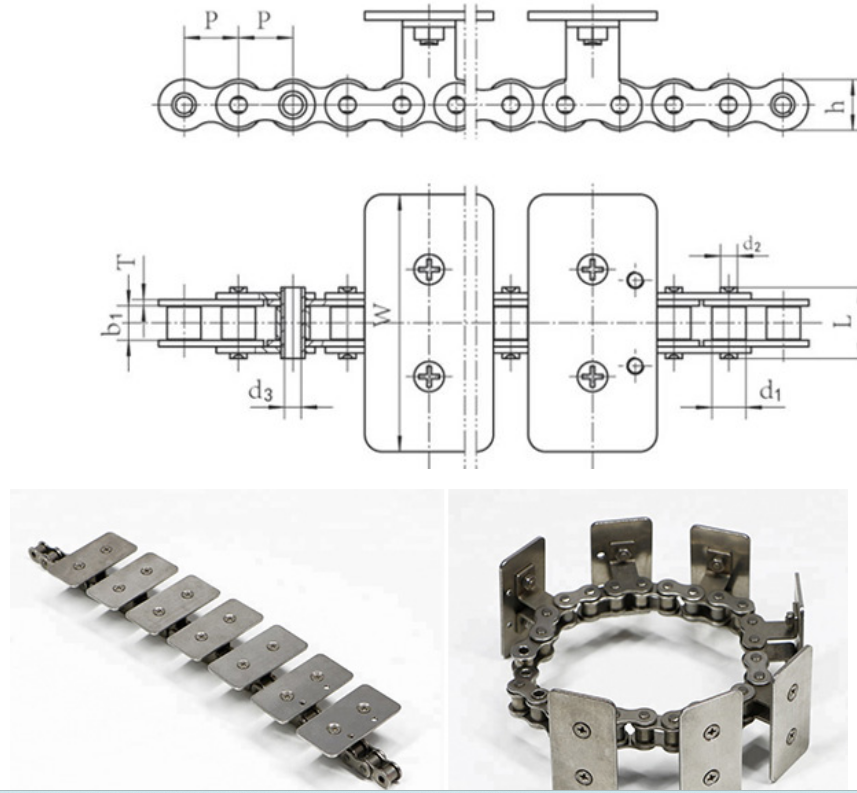
1. What Are Gripper Chains?
A gripper chain is a specialized industrial chain equipped with mechanical gripping elements designed to hold, guide, and transport materials or products during automated manufacturing and packaging processes.
Unlike standard roller chains, which primarily transmit mechanical power or move conveyor attachments, gripper chains provide controlled gripping force throughout the conveying process.
Depending on the application, gripping elements may include:
Spring-loaded clamps.
Mechanical fingers.
Rubber gripping pads.
Specially designed gripping attachments.
These mechanisms help maintain stable positioning and consistent tension while minimizing slipping, misalignment, or product damage.
Gripper chains are commonly used in vertical form-fill-seal (VFFS) machines, flexible packaging equipment, and specialized product-handling systems.
2. How Do Gripper Chains Work?
Gripper chains operate through a controlled gripping and releasing mechanism. Their movement is synchronized with the packaging machine to ensure accurate material handling.
The typical working process includes four stages:
Step 1: Chain Movement
The gripper chain travels around sprockets along a predetermined path, following the movement of the packaging machine.
Step 2: Automatic Clamp Opening
As the gripping elements reach the loading position, a mechanical mechanism or cam arrangement opens the spring-loaded clamps.
Step 3: Material Gripping
The packaging film or product enters the gripping area. The clamps close and hold it securely, maintaining the required position and tension.
Step 4: Controlled Transportation and Release
The chain transports the material through filling, sealing, cutting, or other processing stages. At the designated release position, the gripping mechanism opens to release the material.
This controlled movement helps improve packaging accuracy and reduce material slippage, wrinkles, and tearing.
The exact opening and closing mechanism depends on the gripper chain design and machine configuration.
3. Types of Gripper Chains
Different packaging machines require different gripping configurations. The appropriate design depends on the material being handled, required gripping force, machine speed, and installation layout.
3.1 Standard Gripper Chains
Standard gripper chains use spring-loaded mechanical clamps to hold flexible materials during transportation.
They are commonly used for:
Plastic packaging films.
Flexible packaging materials.
Vertical packaging machines.
Continuous film feeding systems.
Their main advantage is consistent gripping force and reliable material positioning.
3.2 K-Style Gripper Chains
K-style gripper chains feature a specific gripping attachment configuration designed for particular machine layouts and material-handling requirements.
They are selected according to the required gripping position, chain dimensions, and equipment specifications.
3.3 Horizontal Gripper Chains
Horizontal gripper chains are designed for applications where materials or products need to be held and transported along a horizontal path.
They can be used in specialized packaging and converting machinery where stable positioning and controlled movement are essential.
Important: Standard, K-style, and horizontal gripper chains are not necessarily interchangeable. Buyers should confirm the attachment geometry, opening mechanism, chain pitch, and machine compatibility before ordering.
4. Other Common Types of Chains Used in Packaging Machinery
Besides gripper chains, packaging production lines use several other chain types for power transmission, product conveying, positioning, and synchronization.
4.1 Roller Chains
Roller chains are among the most widely used industrial chains. They transmit mechanical power between shafts and drive various moving components in packaging equipment.
Common ANSI sizes include #40, #50, #60, and #80, although the appropriate size depends on operating speed, load, and drive design.
Advantages:
High transmission efficiency.
Reliable power transmission.
Good mechanical strength.
Wide availability of standard sizes.
Suitable for synchronized machinery.
Applications: Filling machines, labeling equipment, carton packaging machinery, and automated production lines.
Stainless steel roller chains are particularly useful in food, beverage, pharmaceutical, and other environments requiring frequent cleaning or corrosion resistance.
4.2 Attachment Conveyor Chains
Attachment chains are roller chains fitted with specially designed attachments on their link plates or pins.
These attachments allow the chain to perform additional conveying and positioning functions.
Common attachment types include:
A Attachments: Attachments with one-side mounting holes.
K Attachments: Attachments with mounting holes on both sides.
Extended Pin Attachments: Extended pins used to support or connect external components.
Bent Attachments: Specially shaped attachments for customized conveying applications.
Applications: Product pushing, indexing, separating, positioning, and transferring products between packaging stations.
4.3 Double-Pitch Conveyor Chains
Double-pitch conveyor chains feature a pitch approximately twice that of the corresponding standard roller chain series.
Their longer pitch reduces the number of chain components required over a given conveyor length, making them suitable for extended conveying systems with relatively light loads.
Advantages:
Lower chain weight.
Reduced component count.
Cost-effective for long conveyor layouts.
Available with different attachments.
Suitable for light- and medium-duty conveying, depending on design.
Common configurations include standard roller types, large roller types, attachment types, and stainless steel versions.
Applications: Carton conveying, packaging lines, assembly systems, and long-distance material handling.
4.4 Flat Top Chains
Flat top chains feature a relatively flat conveying surface that provides stable support for products moving along a conveyor.
They are commonly used where packages need to remain upright and stable during transportation.
Advantages:
Stable product support.
Suitable for straight conveyor layouts.
Good load-bearing capabilities depending on design.
Smooth product transfer between processing stages.
Applications: Carton handling, boxes, trays, and packaged goods.
4.5 Table Top Chains
Table top chains consist of interconnected plates that form a continuous conveying surface. Many designs support side-flexing movement, allowing products to travel through curved conveyor layouts.
They are particularly popular in beverage and food packaging facilities.
Advantages:
Smooth and stable product transportation.
Suitable for straight and curved conveyors.
Flexible conveyor layout.
Available in plastic and stainless steel designs.
Suitable for continuous high-speed production when properly engineered.
Applications: Bottle filling, can conveying, beverage packaging, and food processing lines.
4.6 Other Specialized Chains
Other chain designs may also be used in packaging machinery:
Silent Chains: Designed for relatively quiet, smooth power transmission at suitable operating speeds.
Modular Plastic Chains: Lightweight conveying chains with modular construction, suitable for food and beverage handling.
Maintenance-Free Chains: Incorporate self-lubricating materials or components to reduce lubrication requirements in suitable operating environments.
5. Comparison of Common Packaging Conveyor Chains
Different chain types perform different functions. The following comparison can help identify suitable options for specific machinery.
Chain Type | Main Function | Typical Application |
|---|---|---|
Gripper Chain | Hold and control materials | Film feeding and packaging |
Roller Chain | Power transmission | Machine drives |
Attachment Chain | Position and move products | Indexing and product transfer |
Double-Pitch Chain | Long-distance conveying | Carton handling |
Flat Top Chain | Stable product support | Boxes and trays |
Table Top Chain | Continuous product conveying | Bottles and cans |
Modular Plastic Chain | Flexible material handling | Food and beverage lines |
Silent Chain | Low-noise power transmission | Precision machinery |
6. Applications of Gripper Chains and Conveyor Chains
Packaging chains are used across a wide range of industries, with different requirements for speed, hygiene, accuracy, and material compatibility.
Food and Beverage Packaging
Gripper chains guide flexible packaging films through filling, sealing, and cutting processes. Table top and modular plastic chains transport bottles, cans, trays, and packaged food products.
Important requirements include:
Corrosion resistance.
Cleanability and hygiene.
Stable product positioning.
Reliable operation during frequent washdowns.
Pharmaceutical Packaging
Pharmaceutical production requires accurate product positioning and controlled material handling.
Gripper chains can guide packaging films, while precision roller and conveyor chains support automated packaging equipment.
Suitable chain materials and designs should be selected according to cleaning procedures and applicable hygiene requirements.
Carton and Box Packaging
Attachment chains, double-pitch chains, and flat-top chains are commonly used to transport cartons and packages through folding, filling, sealing, and labeling operations.
They help maintain consistent product spacing and synchronization between machine stations.
Flexible Packaging
Gripper chains are particularly useful in flexible packaging machinery because they maintain film tension and positioning throughout the packaging process.
Typical applications include:
Plastic film packaging.
Vacuum packaging.
Vertical form-fill-seal machinery.
Food and agricultural product packaging.
7. How to Choose the Right Chain for Packaging Machinery
Selecting the right chain requires more than matching the chain dimensions. Engineers should evaluate the machine's operating conditions, load requirements, conveying layout, and product characteristics.
7.1 Identify the Application
First, determine the chain's primary function.
Application Requirement | Recommended Chain |
|---|---|
Film gripping and transportation | Gripper Chain |
Mechanical power transmission | Roller Chain |
Product positioning and indexing | Attachment Chain |
Long-distance conveying | Double-Pitch Chain |
Carton and tray transportation | Flat Top Chain |
Bottle and can transportation | Table Top Chain |
Low-lubrication operation | Maintenance-Free Chain |
7.2 Consider Load and Operating Speed
The chain must withstand the actual working load, starting forces, acceleration, and operating speed.
For high-speed packaging machinery, smooth engagement, accurate synchronization, and dynamic loading are especially important.
7.3 Select the Right Material
Material selection affects corrosion resistance, wear performance, strength, and maintenance.
Material | Main Characteristics | Typical Applications |
|---|---|---|
Carbon Steel | High strength and cost-effectiveness | General industrial machinery |
Stainless Steel | Corrosion resistance and cleanability | Food and beverage packaging |
Nickel-Plated Steel | Improved surface corrosion protection | General packaging environments |
Engineering Plastic | Lightweight and corrosion-resistant | Product conveying |
Hardened Alloy Steel | High wear and fatigue resistance when properly designed | Heavy-duty transmission |
For food-contact or hygiene-sensitive environments, material suitability should be verified against the relevant application and regulatory requirements.
7.4 Check Conveyor Layout
The conveyor configuration also affects chain selection.
Consider:
Straight or curved conveyor paths.
Horizontal or vertical transportation.
Required turning radius.
Sprocket diameter and tooth profile.
Chain tension and support arrangements.
Available installation space.
7.5 Evaluate Maintenance Requirements
Regular inspection helps prevent unexpected equipment downtime.
Consider chain lubrication, cleaning frequency, wear resistance, replacement-part availability, and ease of installation.
8. Maintenance Tips for Longer Chain Service Life
Even well-designed industrial chains require proper maintenance to maintain reliable operation.
Recommended practices include:
Check chain tension: Incorrect tension can increase wear and cause unstable movement.
Inspect sprockets: Worn sprocket teeth can lead to poor engagement and accelerated chain wear.
Monitor chain elongation: Check pin and bushing wear, especially in continuously operating equipment.
Clean regularly: Remove dust, product residue, and other contaminants.
Lubricate correctly: Follow the manufacturer's lubrication recommendations. Avoid inappropriate lubricants in food-processing environments.
Inspect gripping components: Check spring clips, rubber pads, and mechanical fingers for damage or reduced gripping force.
Replace worn parts promptly: Damaged attachments and gripping components can affect packaging accuracy and product quality.
For gripper chains, special attention should be paid to clamp opening and closing performance, spring condition, gripping pressure, and material alignment.
9. Frequently Asked Questions (FAQs)
Q1: What is the main difference between a gripper chain and a roller chain?
A roller chain primarily transmits mechanical power or moves attached components. A gripper chain incorporates specialized clamps or gripping elements to hold and transport materials securely.
Q2: Are gripper chains suitable for food packaging machines?
Yes. Stainless steel gripper chains are commonly used in food packaging applications, particularly where corrosion resistance and frequent cleaning are required. The complete design and materials should meet the machine's hygiene requirements.
Q3: What materials are commonly used for gripper chains?
Common options include stainless steel and nickel-plated steel. The choice depends on corrosion exposure, budget, operating conditions, and sanitation requirements.
Q4: What is the difference between flat top chains and table top chains?
Flat top chains provide stable conveying surfaces and are commonly used for cartons, boxes, and trays. Table top chains consist of interconnected plates, often with side-flexing capabilities, making them suitable for bottles, cans, and curved conveyor layouts.
Q5: Which chain is best for high-speed packaging machinery?
It depends on the machine's function. Precision roller chains are suitable for synchronized power transmission, gripper chains for accurate film handling, and table top chains for continuous product transportation.
Q6: Can gripper chains be customized?
Yes. Gripper chains can be customized in terms of pitch, length, gripping mechanism, clamp configuration, material, and attachment design to match specific machine requirements.
Q7: How often should packaging conveyor chains be replaced?
There is no universal replacement interval. Replacement should be based on chain elongation, wear, corrosion, gripping performance, operating hours, and the manufacturer's maintenance recommendations.
GIDI CHAIN LIMITED supplies roller chain, conveyor chain, Leaf Chain, welded chain, forged chain, Palm Oil Mill Chain, Hoisting Chain, Mine and Metallurgy Chain, etc., totaling over 3000 varieties. and 90% of chains are exported worldwide, mainly to Southeast Asia, Europe, North America, and South America. Chains are welcomed by customers for their excellent quality. Our company owns more than 100 sets of advanced and professional manufacturing equipment. A Perfect and rigorous QC system is implemented in every process from material purchasing to finished product packaging. Also, we have passed the ISO9001:2015 Quality Management System Certification.
More Detail: www.gidi-chain.com