
Introduction
In modern automated production lines, efficient and reliable material handling is essential for improving productivity and reducing downtime. Among various conveyor chain solutions, gripper chains for food packing machine have become widely used in industries that require stable positioning, precise transportation, and secure handling of products.
Unlike standard conveyor chains that only move materials on a flat surface, gripper chains are equipped with specially designed gripping attachments that can hold, clamp, or guide products during transportation. This unique structure makes them ideal for applications where products need to be conveyed vertically, transferred between stations, or maintained in a fixed position during processing.
Gripper chains are commonly used in industries such as packaging, food and beverage, automotive, electronics, and manufacturing automation, providing a flexible solution for complex conveying requirements.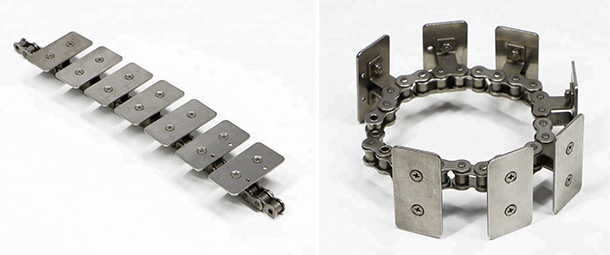
What Are Gripper Chains?
A gripper chain is a type of industrial conveyor chain fitted with customized gripping components, usually made from plastic, rubber, stainless steel, or other wear-resistant materials. These attachments extend from the chain links and securely hold products while the chain moves through the conveyor system.
Depending on application requirements, gripper chains can be designed with different attachment forms, including:
Rubber gripping pads
Plastic clamps
Stainless steel gripping fingers
Adjustable holders
Special-shaped fixtures
The main purpose of these attachments is to prevent products from slipping, falling, or shifting during transportation.
Compared with traditional conveyor chains, gripper chains provide better control and positioning accuracy, making them especially suitable for automated production environments.
How Do Gripper Chains Work?
The working principle of a gripper chain is relatively simple. The chain runs continuously around sprockets, while the attached grippers hold the product securely as it moves along the conveyor path.
During operation:
Product Loading
Products are placed between or onto the gripping attachments at the loading point.
Secure Holding
The grippers apply controlled pressure to keep products stable during transportation.
Continuous Conveying
The chain moves through straight sections, curves, inclines, or vertical sections while maintaining product positioning.
Product Release
At the unloading station, the gripper design allows products to be released smoothly without damage.
The gripping force can be customized according to product size, weight, and surface characteristics. Soft materials can be used for delicate products, while stronger metal attachments are suitable for heavy-duty applications.
Key Features of Gripper Chains
1. Secure Product Handling
The biggest advantage of gripper chains is their ability to hold products firmly during movement.
This is particularly important when transporting:
Bottles
Containers
Packaging materials
Automotive components
Electronic parts
By preventing product movement, gripper chains reduce the risk of damage and improve production consistency.
2. Suitable for Inclined and Vertical Conveying
Standard conveyor systems may struggle with inclined or vertical transportation because products can slide or fall.
Gripper chains solve this problem by securely clamping products during movement. This allows manufacturers to design more compact production layouts and save valuable factory space.
Applications include:
Vertical transfer systems
Elevating conveyors
Multi-level production lines
3. High Precision and Stability
Automated manufacturing processes often require accurate product positioning for operations such as:
Filling
Labeling
Assembly
Inspection
Packaging
Gripper chains maintain consistent product orientation and spacing, improving the accuracy and efficiency of downstream processes.
4. Flexible Customization Options
One of the major advantages of gripper chains is their adaptability.
Manufacturers can customize:
Chain pitch
Attachment type
Gripper material
Holding force
Chain length
Conveyor configuration
For example, soft rubber grippers are suitable for fragile products, while stainless steel attachments are better for high-temperature or heavy-duty applications.
Common Applications of Gripper Chains
Beverage and Packaging Industry
Gripper chains are widely used in beverage production lines for transporting bottles and containers.
They help move products through processes such as:
Filling
Capping
Labeling
Inspection
Packaging
The stable grip prevents bottles from tipping or shifting during high-speed production.
Food Processing Industry
In food manufacturing, hygiene and reliability are critical. Stainless steel gripper chains are commonly used because they provide corrosion resistance and easy cleaning.
Typical applications include:
Food container handling
Processing equipment
Packaging systems
Automotive Manufacturing
Automotive production lines often require accurate movement of components through multiple assembly stages.
Gripper chains are used for transporting:
Engine parts
Plastic components
Metal assemblies
Interior components
Their high load capacity and precise positioning improve automation efficiency.
Electronics Manufacturing
Electronic components require careful handling to avoid damage.
Customized gripper chains provide stable transportation while minimizing vibration and movement, making them suitable for precision assembly lines.
Materials Used for Gripper Chains
The choice of material depends on operating conditions.
Stainless Steel
Stainless steel gripper chains provide:
Excellent corrosion resistance
High strength
Temperature resistance
Long service life
They are suitable for food processing, chemical industries, and harsh environments.
Engineering Plastics
Plastic grippers offer:
Low friction
Lightweight design
Reduced product damage
Quiet operation
They are commonly used for consumer products and lightweight materials.
Rubber Attachments
Rubber gripping surfaces provide:
Better friction
Soft contact
Protection for delicate products
They are ideal for glass bottles, packaging, and sensitive components.
Benefits of Using Gripper Chains
Improved Production Efficiency
By maintaining stable product movement, gripper chains reduce interruptions and improve automated line performance.
Reduced Product Damage
Secure gripping prevents products from falling or shifting, reducing waste and improving quality.
Space-Saving Conveyor Design
The ability to handle vertical and inclined transportation allows factories to optimize production layouts.
Lower Maintenance Costs
High-quality gripper chains offer excellent wear resistance and durability, reducing replacement frequency.
How to Select the Right Gripper Chain?
When choosing a gripper chain, manufacturers should consider:
Product Characteristics
Consider product size, weight, shape, and surface material.
Operating Environment
Temperature, humidity, chemicals, and hygiene requirements affect material selection.
Conveyor Speed
High-speed production lines require chains with excellent stability and wear resistance.
Load Capacity
Heavy products require stronger chains and reinforced attachments.
Conclusion
Gripper chains are an important component in modern conveyor systems, offering reliable product handling, precise positioning, and flexible transportation solutions. Their ability to securely grip products makes them especially valuable for automated production lines involving vertical conveying, high-speed movement, and complex handling requirements.
With customizable designs, various material options, and excellent performance across industries, gripper chains continue to support efficient manufacturing in packaging, food processing, automotive, electronics, and industrial automation sectors. Choosing the right gripper chain solution can help companies improve productivity, reduce downtime, and achieve more reliable production operations.
GIDI CHAIN LIMITED supplies roller chain, conveyor chain, Leaf Chain, welded chain, forged chain, Palm Oil Mill Chain, Hoisting Chain, Mine and Metallurgy Chain, etc., totaling over 3000 varieties. and 90% of chains are exported worldwide, mainly to Southeast Asia, Europe, North America, and South America. Chains are welcomed by customers for their excellent quality. Our company owns more than 100 sets of advanced and professional manufacturing equipment. A Perfect and rigorous QC system is implemented in every process from material purchasing to finished product packaging. Also, we have passed the ISO9001:2015 Quality Management System Certification.
More Detail: www.gidi-chain.com